
Donate to the Tree Lovers' Fund
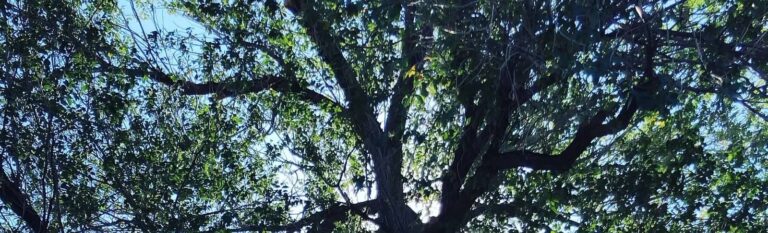
Nob Hill is distinguished by its historic architecture and its historic urban forest. Along with beauty, our mature trees improve air quality, reduce stormwater runoff, provide carbon sequestration, and help shield us from the “heat island effect”. The heat island effect refers to the concentration of heat, built up during the day and held overnight, in locations composed primarily of heat trapping materials (e.g., concrete, asphalt, rock) and lacking trees and other shade coverage.
Our wonderfully shady Nob Hill needs all of us working to protect and promote our urban forest. You can do your part by caring for your existing trees and planning for tree succession in your residential space.
Caring for Our Tree Canopy
In Albuquerque’s dry climate, even mature trees need to be watered. This is especially true during times of drought. Please help preserve Nob Hill’s urban forest by watering your existing trees regularly. How often to water depends on the season. The 505Outside “Water by the Seasons” guide can help you estimate how much water your trees need at various times of year.
How to water existing trees: According to 505Outside, mature trees need to have water dispersed throughout the main root zone in a manner that allows the water to soak in slowly rather than run off. Most tree roots are located within the top two to three feet of the soil surface. The root parts best able to absorb water are located at the dripline of the tree; that is, the outermost edge of the tree canopy where water (like rain) drips off the leaves and onto the ground. One-inch in-line emitter drip tubing, laid out in a spiral or concentric circles at the dripline of the tree, does a great job of irrigating trees in an optimal manner. Alternatively, as described on the Tree New Mexico website, you can set down your hose about halfway between the trunk and the dripline of the tree and allow it to dribble VERY slowly to a depth of about 24 inches. If water is running off the watering site, it is dribbling too quickly.
How much water is enough? You want to water your trees to a depth of about 24 inches. You can test the depth of watering by pressing a long screwdriver or similar object (piece of rebar, a metal rod, etc.) into the ground where you are watering. The screwdriver will go into the ground only as deep as there is moisture. If it doesn’t go down at least 24 inches, water that area longer. For more information see Tree New Mexico: Everything You Need to Know About Effective Tree Watering.
What about new trees? Newly planted trees may need more frequent watering for the first year or so after planting. Water newly planted trees at the base, making sure to wet the entire root ball area. Check soil moisture as described above. New trees may need to be watered as often as twice a week during the first growing season. Make sure to expand the diameter of the watering zone as your tree grows.
Don’t forget mulch. Placing four inches of wood mulch around the base of smaller trees or under the canopy of larger trees is a tremendously effective way to hold in soil moisture. As a bonus, it also breaks down and provides fertilizer for your tree. Free mulch, which you haul yourself, can be obtained from Baca Trees (7933 Edith Blvd NE) and other tree services. Chip Drop is a service that connects gardeners with arborists to provide free delivery of large quantities of wood mulch, which you then move from the drop site (usually a driveway) to your desired locations.
Planning for Urban Forest Succession
Like Nob Hill itself, our tree canopy was established decades ago. That means many trees are, or soon will be, facing the end of their lifespans. Without thoughtful tree succession, Nob Hill will be left without our beloved, and protective, tree canopy.
Making good choices. As we each plan for tree succession, we need to bear in mind that urban forest health relies on choosing appropriate tree species, placing those trees in appropriate planting sites, and assuring that they are well-cared for. Climate-Ready Trees: Tree Species Selection Guidelines for the Albuquerque Metro Area contains a wealth of information for those wanting to plant new trees. The report includes lists of climate-ready trees (i.e., those that will be able to thrive in Albuquerque’s anticipated future climate) that are best suited for seven different location types. While only the wonkiest of us will want to read the entire report, chapter 3 and Appendices A and B are particularly helpful for tree enthusiasts.
Passive Rainwater Harvesting. Would you like to use rainwater to irrigate your trees, while also protecting the health of our watershed? The Field Guide to Passive Rainwater Harvesting, shows you how. The Field Guide and its companion online resources share knowledge and experience from local experts on how to harvest rainwater in our high desert communities at a residential scale.
“Tree-bates”. The cost of your new trees can be off-set through the Water Authority’s Tree-bate program. Other Water Authority rebate programs that may be interest to Nob Hill residents include the Desert Friendly Xeriscape Conversion Rebate, the Rainwater Harvesting Rebate, and the Efficient Irrigation Rebate.
Tree Lovers' Fund
Are you a fellow tree lover? Do you want to promote Nob Hill’s beautiful tree canopy?
The NHNA Tree Canopy Restoration Committee (TCRC) is looking for fellow tree lovers to help support the Nob Hill Tree Lovers’ Fund. The purpose of this fund is to provide financial incentives to promote tree planting in Nob Hill. Our goal for this inaugural year: plant 26 trees in 2026!
Like Nob Hill itself, our tree canopy was established decades ago. That means many trees are, or soon will be, facing the end of their lifespans. Without thoughtful tree succession, Nob Hill will be left without our beloved, and protective, tree canopy.
Benefits of Trees
Along with their beauty, trees improve air quality, reduce stormwater runoff, and fight climate change through carbon sequestration and protection from the “heat island effect” (i.e., concentration of heat in locations composed primarily of concrete, asphalt, and rock). In addition, trees protect biodiversity and increase property values. Strategically placed shade trees can provide energy savings to homeowners.
How Will it Work?
Interested neighbors will apply to the Tree Lover’s Fund for a 50% price match, to a maximum of $50, per eligible tree planted.
Maximizing Success
To be eligible for funding from the Nob Hill Tree Lovers’ Fund, recipients will follow best-practices to assure Right Tree, Right Place.
How to Contribute
Contributions to the Tree Lovers’ Fund can be made through the NHNA Tree Canopy webpage (see donate link at top of page). Or you may contribute by mailing a check to Nob Hill Neighborhood Association, PO Box 4875, Albuquerque, NM 87196. Be sure to specify Tree Lovers’ Fund on the memo line of your check.
In addition to contributions from neighbors, the TCRC has secured a small grant from Bernalillo County to kick off this funding effort.
How to Apply
Interested neighbors may apply for Tree Lovers’ Fund matching funds through the NHNA TCRC webpage.
Tree Lovers' Fund Application
The NHNA Tree Canopy Restoration Committee has established the Tree Lovers Fund for the purpose of off-setting the cost of planting trees in the Nob Hill neighborhood. Up to 26 grants will be made during the 2026 calendar year.
Nob Hill residents who plant eligible trees under eligible conditions can apply for a 50% price match, to a maximum of $50, per tree planted.
Eligible trees:
- The selected tree is listed in Climate-Ready Trees: Tree Species Selection Guidelines for the Albuquerque Metro Area (Nature Conservancy 2020) for the relevant planting site type (e.g., xeriscaped area, small Green Stormwater Infrastructure features, etc.) OR The tree is included in the ABC Water Authority TreeBate program, as noted in Xeriscaping: The Complete How-to Guide (see tree list beginning on page 12).
- The selected tree is suitable to site conditions (e.g., overhead clearance, soil area for root development).
- The tree is planted using best practices as established by Tree New Mexico. Tree Canopy Restoration Committee members are available to assist with proper tree planting. Email theboard@nobhill-nm.com.
- While not a requirement, the Tree Canopy Restoration Committee recommends the planting of smaller trees (e.g., 2-gallon trees) as opposed to larger trees. Smaller tree become established in our native soils quickly and present less concern with girdling roots. After 5 years, 2-gallon trees have often caught up with 5-gallon trees in size due to their stronger start.
Eligible conditions:
- The Owner accepts responsibility for identifying irrigation lines, other lines and/or structures of which Owner knows that should not be disturbed in the general area where the tree would be planted.
- The Owner accepts responsibility for proper watering, mulching, and maintenance of the tree according to general standards provided to Owner by the NHNA Tree Canopy Restoration Committee.
- The Owner agrees to pull back any existing landscape fabric/plastic to at least five feet away from the trunk of the tree. For best growing conditions, landscape fabric should be removed altogether.
- The Owner accepts responsibility for protecting the tree from damage (e.g., trunk damage from lawn mowers or weed whackers).
Community Benefit:
- The Owner acknowledges that the tree planting site will not exceed 20 feet from the street. This is consistent with the goal to subsidize trees that will benefit the community at large as well as the property owner.